Address
304 North Cardinal
St. Dorchester Center, MA 02124
Work Hours
Monday to Friday: 7AM - 7PM
Weekend: 10AM - 5PM

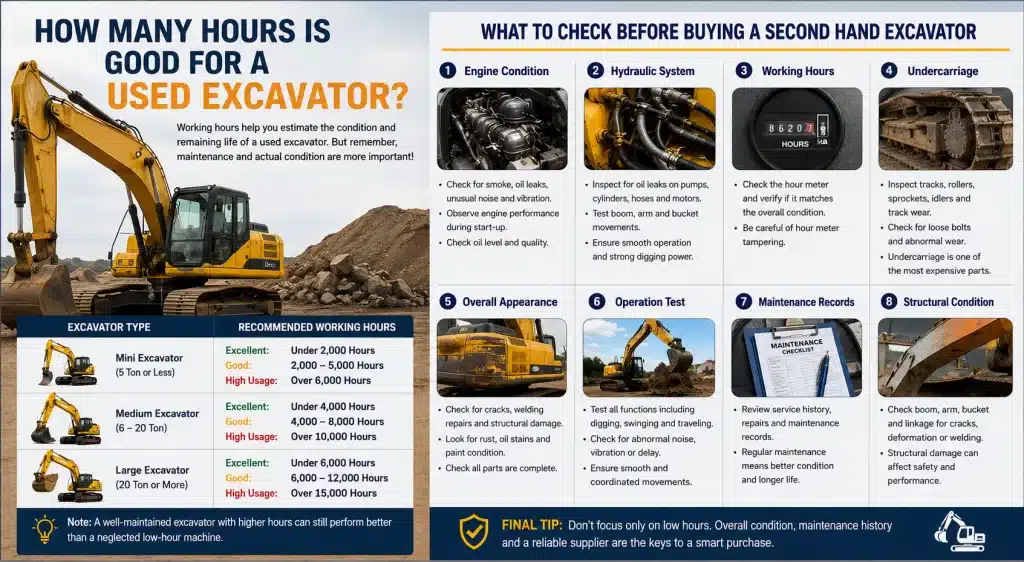
When buying a used excavator, one of the first things buyers usually check is the machine’s working hours. Working hours can help estimate how heavily the excavator has been used and how much lifespan may remain.
However, many buyers misunderstand the importance of working hours. A low-hour excavator is not always in better condition, while a high-hour machine may still perform reliably if it has been properly maintained.
In this guide, we will explain how many hours are considered good for a used excavator and what other factors buyers should inspect before purchase.
Excavator working hours are similar to mileage on a car.
Higher working hours generally mean:
Key components affected by long working hours include:
However, working hours alone cannot fully determine machine condition.
Proper maintenance is often more important than the hour meter itself.
Different excavator sizes have different average lifespan expectations.
Mini excavators are commonly used for landscaping, farming, and small construction projects.
Recommended working hours:
| Condition | Working Hours |
|---|---|
| Excellent | Under 2,000 Hours |
| Good | 2,000–5,000 Hours |
| High Usage | Over 6,000 Hours |
Popular mini excavator models include:
Popular mini excavator models include:
Medium excavators are widely used in road construction and earthmoving projects.
Recommended working hours:
| Condition | Working Hours |
|---|---|
| Excellent | Under 4,000 Hours |
| Good | 4,000–8,000 Hours |
| High Usage | Over 10,000 Hours |
Popular models include:
Large excavators are designed for mining and heavy-duty construction work.
Recommended working hours:
| Condition | Working Hours |
|---|---|
| Excellent | Under 6,000 Hours |
| Good | 6,000–12,000 Hours |
| High Usage | Over 15,000 Hours |
Heavy-duty projects usually create faster component wear.
Many buyers believe that low working hours automatically mean excellent machine condition.
This is not always true.
A low-hour excavator may still have problems if:
Machines that sit unused for too long may develop:
Therefore, machine inspection is still essential.
A well-maintained excavator with higher hours may outperform a neglected low-hour machine.
Buyers should check:
Proper maintenance can significantly extend excavator lifespan.
Unfortunately, some sellers may modify the hour meter.
Buyers should inspect:
For example:
If the meter shows 2,000 hours but the machine has heavily worn tracks and controls, the hour reading may not be accurate.
Professional inspection is highly recommended.
Working hours are only one part of excavator inspection.
Buyers should also carefully inspect:
Check for:
Hydraulic repairs can be very expensive.
Inspect:
A stable engine is essential for long-term reliability.
Inspect:
Undercarriage replacement can significantly increase maintenance costs.
Check the boom and arm for:
Structural damage may reduce safety and durability.
Several excavator brands are known for long-term durability and stable performance.
Popular choices include:
Proper maintenance is still more important than brand alone.
Machine condition is more important than the hour meter alone.
Hydraulic problems can be extremely costly.
Operational testing can reveal hidden issues.
Reliable suppliers reduce purchasing risks.
So, how many hours is good for a used excavator?
In general:
However, maintenance history, hydraulic condition, engine performance, and supplier reliability are even more important than working hours alone.
A professionally inspected excavator with proper maintenance can provide excellent long-term value for construction and earthmoving projects.
If you are looking for reliable used excavators from China, Shanghai Shenhu Machinery provides professionally inspected machines ready for global export.